MASH+ News

Mayor launches new solar panels project in Shire

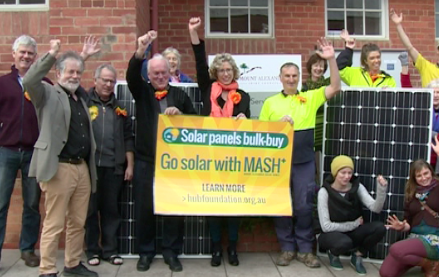
Mount Alexander Shire Mayor, Cr Michael Redden, has launched a new solar power project, Mount Alexander Solar Homes, or MASH+.  MASH+ is a bulk-buy arrangement for local households in Mount Alexander Shire and nearby areas, using high quality solar panels and inverters, heavily discounted prices and as much local involvement as possible.

According to Cr Redden “We are supporting this initiative because we want to help all households in our Shire benefit from the financial benefits of going solar and as a Shire we want to help cut our CO2 emissions.  We are pleased to support another not-for-profit solar initiative in our Shire.  Climate change is a pressing concern for everyone and the more that we can do to address it, the better.”

The project has been organised by The Hub Foundation, a not-for-profit company which is associated with the Hub office and restaurant building in Castlemaine.

Hub Foundation manager, Neil Barrett, says he decided it was a great time to promote solar for five reasons.  “Prices for solar panels have come down enormously over the past few years, people want solar but don’t trust the many people calling them on the phone, the technology is well and truly proven, the government may take away the subsidy within a few months and, above all, the planet needs it.

“And there’s a sixth reason also”, says Barrett: “You can earn a higher rate of return on your money than you do from almost any other investment. That’s because the savings on your power bills are so high and the cost of the panels so low.

“The MASH+ project is very local. We’re working with the highly respected electrical contractor, Stephen Breheny.  Stephen and his staff have done over 400 solar installations in the Shire over the past six years and they’re widely respected.

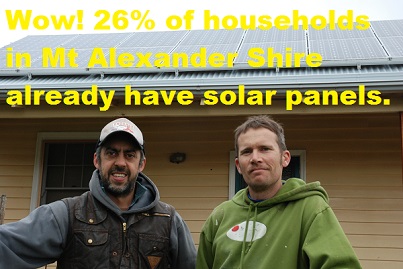
“Currently 26% of the Shire’s houses have solar panels. We’re hoping to raise this to 36% which would put us up there amongst the nation’s leading solar regions.

On the 10th and 16th of July the Foundation will be holding information sessions in Castlemaine, Campbells Creek and Maldon, for interested people.

And the plus in MASH+? That’s there to tell you it’s not just about solar power. As part of the price, participants in the project also get an energy assessment and a voucher for an energy efficiency kit from a local supplier.

For more information, call Neil Barrett on 0455 589 065 or visit hubfoundation.org.au
 

Solar Lowdown

The solar boom

The global solar industry is booming, with an average growth rate of around 20% over the past four years. Solar is now a significant part of the global energy supply here and overseas. In South Australia, 25% of homes are now powered by solar, with an average size of 4.8Kw or around 25-30 panels per house (see table). In Queensland  it’s  around 22% of homes whilst in Victoria it’s 10%.  Remarkably in our Shire, the penetration is already 26%.

Solar PV in Australia, 2013

State/Territory

# PV Systems

Capacity (MW)

% dwellings with solar power
ACT 14,000 38 10
NSW 252,000 633 10
NT 3,000 11 4
SA 160,000 450 25
TAS 18,000 55 9
VIC 201,000 532 10
WA 149,000 334 18
National 1,157,000 3,039 14
Mount Alexander Shire 2250 6 (approx) 26

Source: Renew Economy 4th Dec 2013; Powercor, personal communication, 28th March 2014

Solar PV is also helping to stabilise our energy system. During the heatwaves of January 2014, it supplied around 6% of demand, thereby allowing the electricity retailers to avoid blackouts.

Government rebates and feed-in tariffs have certainly helped fuel the boom, developments in solar technology have also played a large part: in recent years the actual cost of solar pv has fallen by around 80%. 10 years ago, the cost of solar was over $10 per watt. Today, it’s much less than $2 per watt. The great bulk of the decrease has taken place in the last 2-3 years.

Already, for a new power station,  solar is competitive with fossil fuels without any subsidy at all.  That’s highly significant as the playing field is not a level one: solar’s main competitor, coal, is still not paying the cost of its pollution.

Not surprisingly, the solar boom has come at a cost to the electricity generators and the coal companies. Solar has actually helped to cause the level of demand for fossil fuel-based electricity to fall which has in turn resulted in a fall in the wholesale price of electricity and a lower demand for coal.

Because  solar’s peak production takes place during peak consumption hours, the time when the big generators make most profits, the boom has been  more damaging to the generators’ business than might have been imagined. As a result, the generators and the coal companies are doing everything they can to stop the progress of solar and other renewable forms of energy. And sadly, in Australia at present they have the federal government and most state governments on their side.

Ultimately, however, most independent energy experts believe that big energy will go the way of letters, film developing and over- the-counter banking. The forces involved are too strong to be held back for long as the prices of solar panels and the batteries which will store energy will continue to fall.

Above all, solar is helping us cut our emissions of CO2. Each 2Kw rooftop solar system in Castlemaine cuts CO2 emissions by over 2 tonnes pa.

Solar Lowdown

The Renewable Energy Target

Australia has had a renewable energy target for around 13 years. The first very limited target of 9500GWh  was introduced by the Howard government in 2001. A much higher target of 41,000GWh was introduced by the Labour government in 2010. This mandatory target enables the market to put a value on Small-scale Technology Certificates, or STCs.

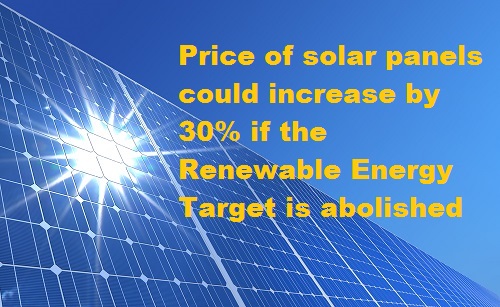
At present, 1kW of panels earns 17 STCs at around $31 each. This is a significant part of the overall solar price.  STCs in fact make up around one third of the solar price in our bulk buy scheme. So if the Renewable Energy Target is abolished later in 2014, as now seems likely, the price of solar could rise by that percentage.

It therefore makes sense to buy now rather than wait until the RET is abolished or weakened.

Solar Lowdown

The challenge of climate change

Over 97% of scientists researching and publishing papers on climate change believe there is very strong evidence that humans are largely responsible for the increase in temperature over the past 100 years. They are supported by virtually all governments and scientific organisations around the world.  The latest IPPC report (March 2014) makes it clear that climate change is already having adverse effects by causing extreme weather events, bushfires, floods and droughts.

If we are to keep the temperature increase within two degrees, we must leave most of the world’s fossil fuel reserves in the ground. If we don’t do this, according to the UN body, the IPCC, we could face increases of up to six degrees by the end of the century. This would make life on earth, as we know it, virtually impossible.

It is therefore vital that we conserve energy and develop renewable forms of energy, in particular solar, wind, bioenergy and geothermal.

The  International Energy Agency which was once a strong promoter of fossil fuels has in recent years put its weight behind renewables.  In fact, the Agency now argues that over two thirds of the existing reserves of fossil fuels must be left in the ground if we are to have a chance of avoiding serious climate change.

The population of Mount Alexander Shire is responsible for around 150,000 tonnes of CO2 emissions each year. We should be aiming to reduce this markedly by 2020 to close to zero by 2050. To do this we need to start now.

Clearly, the technology is available. Wind power has been used for many decades as has solar pv which was first developed for the US space program in the 1950s.  All that is needed is the political will of governments and/or the individual and community will of ordinary citizens.

If governments fail us, we can step into the breach.  We can campaign, we can protest and perhaps above all, we can put our own houses in order by cutting our energy use and by installing renewable energy systems.

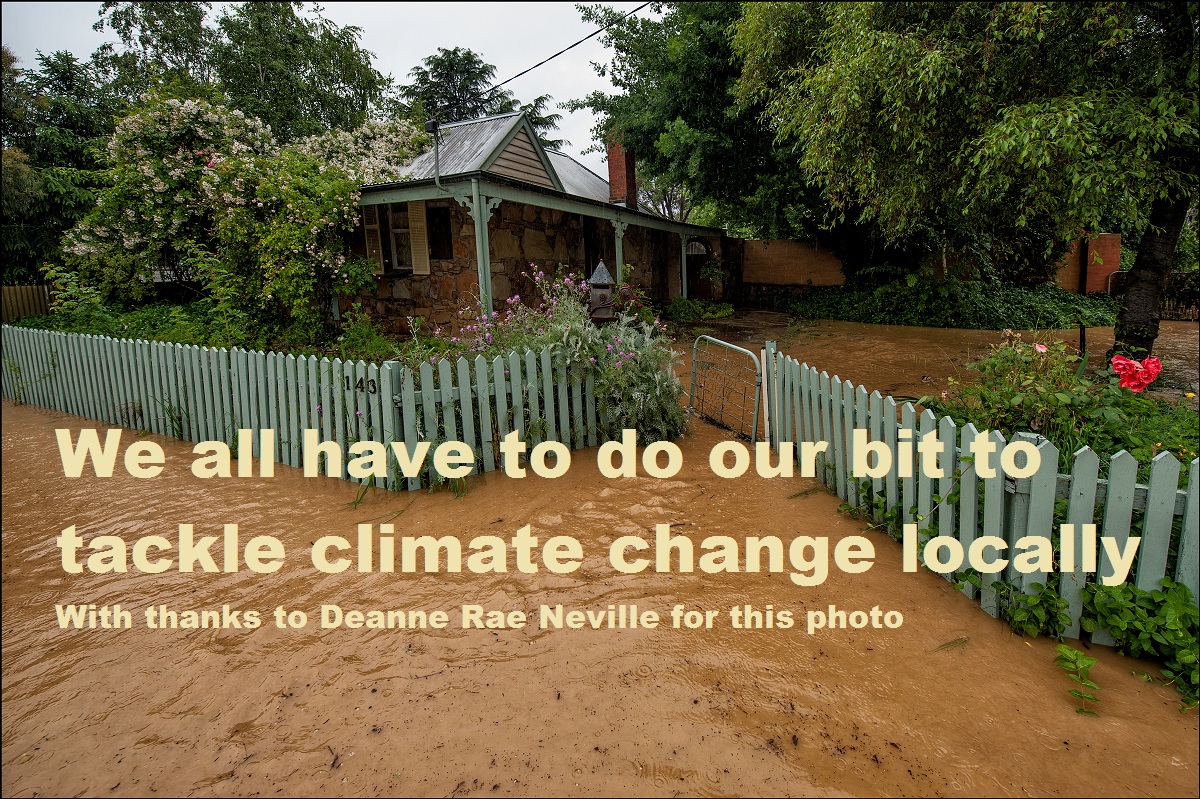
Photo credit: Deanna Rae Neville

Further reading:

‘How Conservative is the Abbott government’s climate change plan?‘, The Saturday Paper, March 15 2014

‘IPCC climate change report: Human role in global warming now even clearer‘, ABC News, 28 September 2013

Solar Lowdown

The barriers to solar

Our research has highlighted the barriers to taking up solar. One is that people don’t trust the many companies whose telemarketers are annoying them on the phone. Will the work be done and done safely? Will there be hidden costs which were not mentioned prior to the day of installation? Will the tree shading my roof be a problem? These are all questions which cause anxiety for householders.

Another barrier is what may be called `technology confusion’. Because there are many types and quality of panel and inverter on the market, it’s very difficult for the average householder to decide what’s best. As a result, many people have decided to wait until an offer they can trust comes along.

A third barrier is cost. Although solar prices have fallen a lot, one-off installations  are still relatively expensive for many people.

With MASH+ we are breaking through all these barriers. You have a trusted supplier recommended by other organisations, you can have the different panels and inverters clearly explained and you can pay a discounted price up-front or over time.

Solar Lowdown

Why Go Solar?

Here are the top 3 reasons why we believe it’s worth putting solar panels on the roof of your home.

1. Save money on your power bills

Depending on when you use electricity and the price per kWh, a solar system will pay for itself in 6-10 years. So if you’ve got a few thousand dollars sitting in the bank, it would make sense to put it into solar. Or if you haven’t, you can buy the panels with a loan from a bank, finance company or credit union. With the right payment arrangement, your outlays can stay much the same as your past power bill and you own the system in the end. (Note that because we are not qualified to give financial advice, you should check with your financial adviser first).

2. Reduce your CO2 emissions

By going solar you are taking one of the best actions available to you to fight climate change. Every kW of solar (around 6 panels) saves up to a tonne or more of CO2 per year.

3. A step towards going off the grid

It is now becoming possible, with the aid of solar and batteries, for communities to decide to take themselves off the grid. This will result in financial benefits to local communities as the money stays local, greater energy security and greater empowerment of communities.

MASH+ News

Why the war on renewable energy?

Once a leader in renewable energy, Australia is now going against the tide. Claims that renewable energy is pushing up electricity prices are dishonest. As articles in last Saturday’s Age (14 June 2014) make clear the major cause of power price increases over the last few years has been the huge investment in transmission costs due to upgrading of poles and wires. Most industry observers call this ‘gold plating of the network’. Instead of taking more imaginative measures to control peak demand for a few days in summer, the industry has invested heavily to increase its reliability and capacity to provide uninterrupted power on those few days. This has come at a great cost to consumers. Renewable power has accounted for only 9% of the increase in electricity costs.

So why the war? The coal industry and the big generators have campaigned heavily for an end to renewable subsidies. Solar power, particularly, is hurting their business as solar’s peak output occurs in the afternoon when the profits for the generators are highest. Solar has cut peak demand for grid electricity in Australia. It has challenged the business models of those who are doing most damage to our environment.

What’s the likely outcome? In the end solar will win. Its price continues to fall as the technology develops and battery strorage is not far off. The more that the utilities raise their service fees and tariffs, the more people will leave the grid altogether. Eventually, perhaps within 4-5 years, the utilities will realise that it’s futile to oppose renewables; in the meantime however they will help set back Australia’s renewables progress.

MASH+ News

Our Shire a Good Solar Citizen

Mount Alexander Shire has amongst the highest penetrations of solar power in Australia. Today 26% of our rooftops have solar panels on them, compared with only 10% in the whole of Australia. The bad news is that the peak was reached in 2011 when 764 solar systems were installed. That was the year local electricians quadrupled their workforces so that they could instal around 15 new systems per week. Since then, due to cutbacks in feed-in-tariffs, the industry has declined. In 2013, only 223 systems were installed.

Now, however, is a great time to go solar. The return on investment (ROI) is still very good at around 9%-16% (compared with the bank’s rate of around 3%) and the current review of the Renewable Energy Target is likely to result in an increase in solar system prices by up to 30% and a fall in the ROI.